Engineering remains one of the most sought-after career paths in Kerala, and the Kerala Engineering Architecture Medical (KEAM) entrance examination plays a crucial role in securing admission to top BTech colleges in the state. Every year, thousands of students appear for KEAM hoping to secure a seat in prestigious engineering institutions. However, one of the most common questions among aspirants is: “What KEAM score is required to get admission into top BTech colleges in Kerala?”
In this detailed guide, we will explore the expected KEAM 2026 cutoff scores for BTech programs, factors influencing the cutoff, top colleges accepting KEAM scores, and how institutions like KMCT Group of Institutions provide excellent opportunities for engineering aspirants in Kerala.
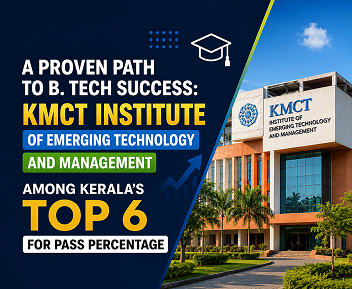
Planning your KEAM 2026 admissions? KMCT Group of Institutions — Kerala's largest educational group with 27+ institutions across 7 campuses in Kozhikode, Malappuram, and Kasaragod — offers KEAM-based BTech admissions in future-ready branches including CSE, AI & Data Science, Cyber Security, and ECE.
Enquire about KMCT BTech Admissions 2026 →
Understanding KEAM and It s Importance
KEAM is conducted by the Commissioner for Entrance Examinations (CEE), Kerala, to facilitate admission into engineering, architecture, and other professional courses across the state. For BTech admissions, the KEAM rank list is prepared using:
- 50% weightage for KEAM entrance exam scores
- 50% weightage for Class 12 marks in Mathematics, Physics, and Chemistry
This combined score determines the rank of candidates in the KEAM merit list. Based on this ranking, students are allotted seats during the centralized counseling process.
Since competition increases every year, understanding the expected cutoff trends helps students plan their preparation strategy and set realistic goals.
What is a KEAM Cutoff?
The KEAM cutoff refers to the last rank at which a seat was allotted in a particular college and branch during KEAM counselling. It is published by the Office of the Commissioner for Entrance Examinations (CEE), Kerala after each round of the Centralised Admission Process (CAP).
To put it simply: if the closing rank for Computer Science Engineering (CSE) at the College of Engineering Trivandrum (CET) is Rank 482 in the general category, then only candidates with a rank of 482 or better (i.e., a lower rank number) would have received a seat in that round.
Key points to understand about KEAM cutoffs:
- Cutoffs are released separately for each college, branch, and reservation category.
- They are published in PDF format on the official website: cee.kerala.gov.in
- Cutoffs are announced after each round of counselling — typically three rounds plus a stray vacancy round.
- The final round cutoff is the most relaxed, but top colleges and high-demand branches like CSE almost always fill up by Round 1.
- There is no single universal cutoff — each college-branch combination has its own closing rank.
How KEAM Rank Is Calculated
Understanding the rank calculation formula is crucial for strategic preparation, as your board marks carry just as much weight as your entrance exam performance.
The 50:50 Weightage Formula
The KEAM Engineering rank is determined by giving equal weightage of 50% each to:
- Normalised KEAM Entrance Exam Score — based on Paper I (Physics & Chemistry) and Paper II (Mathematics), combined out of 300 marks after normalisation.
- Standardised Class 12 Marks — marks in Mathematics, Physics, and Chemistry from your qualifying examination, standardised to 300 marks.
The total score is computed out of 600, and the rank list is prepared in descending order of this combined score.
The Entrance Exam Structure
- Paper I: Physics & Chemistry — 75 questions (45 Physics + 30 Chemistry), 300 marks
- Paper II: Mathematics — 75 questions, 300 marks
- Marking scheme: +4 for each correct answer, –1 for each wrong answer
- Total raw marks: 600 (normalised before rank calculation)
Important for 2026: The KEAM 2025 rank list faced a legal controversy regarding the normalisation formula. The Kerala High Court directed that the original 50:50 formula be retained. For KEAM 2026, students should follow the official prospectus on cee.kerala.gov.in for the exact formula applicable.
Subject Weightage in Board Marks
The board marks are standardised across different boards (Kerala HSE, CBSE, ICSE, etc.) using a normalisation procedure approved by CEE Kerala. Only marks in Mathematics, Physics, and Chemistry are considered. If Chemistry was not studied, marks in Computer Science, Biotechnology, or Biology are considered in that order.
Qualifying Marks
|
Category
|
Minimum Marks Required (out of 480)
|
|
General (SM)
|
240 marks (50%)
|
|
SC / ST
|
192 marks (40%)
|
Candidates scoring below the minimum in any individual paper are also excluded from the rank list.
KEAM Marks vs. Expected Rank (General Category)
|
Score Range (out of 600 combined)
|
Expected Rank Range
|
|
580 – 600
|
Top 100
|
|
550 – 579
|
100 – 500
|
|
520 – 549
|
500 – 1,500
|
|
490 – 519
|
1,500 – 5,000
|
|
450 – 489
|
5,000 – 15,000
|
|
400 – 449
|
15,000 – 30,000
|
|
Below 400
|
30,000+
|
Note: These ranges are approximate and based on trends from 2023–2025. Actual ranks vary each year depending on candidate performance and exam difficulty
Previous Year KEAM Cutoff Trends (2023–2025)
Analysing trends from recent years helps set realistic expectations. Here is what the data tells us:
College of Engineering Trivandrum (CET) — Closing Ranks (General Category, SM)
|
Branch
|
Approx. Closing Rank 2023
|
Approx. Closing Rank 2024
|
Approx. Closing Rank 2025
|
|
Computer Science & Engg. (CSE)
|
~271
|
~300
|
~482
|
|
Electronics & Communication (ECE)
|
~500
|
~530
|
~730
|
|
Electrical & Electronics (EEE)
|
~1,100
|
~1,200
|
~1,768
|
|
Mechanical Engineering
|
~3,000
|
~3,426
|
~3,600
|
|
Civil Engineering
|
~5,200
|
~5,587
|
~5,869
|
Sources: CEE Kerala official allotment data, Careers360, Shiksha, CollegeDunia — closing ranks are final round (last allotment) figures for State Merit (SM) category.
Key Observations from 2023–2025
- CSE at CET remains the most competitive seat in Kerala engineering admissions — closing ranks have tightened from ~271 in 2023 to over 482 in 2025, reflecting growing competition.
- ECE and EEE at top government colleges have also seen moderate tightening over the past three years.
- GEC Thrissur consistently shows CSE closing ranks in the 500–600 range, making it the second most competitive government college for CSE admissions.
- TKM College of Engineering, Kollam, CSE seats closed around rank 1,100, making it accessible to strong candidates outside the top 500.
- RIT Kottayam (Rajiv Gandhi Institute of Technology) CSE has shown closing ranks in the 1,800–2,200 range in recent years.
Civil and Mechanical Engineering seats at most government colleges remain available until ranks between 5,000 and 12,000, making them accessible to a larger pool of candidates
Expected KEAM 2026 Cutoff for Top Colleges
Based on multi-year trend analysis, the following are estimated cutoff ranks for KEAM 2026 admissions. These are projections — actual cutoffs will depend on the 2026 exam difficulty, number of applicants, and seat availability.
Expected KEAM 2026 Branch-Wise Closing Ranks — Top Government Colleges
|
Branch
|
CET Trivandrum
|
GEC Thrissur
|
TKM Kollam
|
GEC Barton Hill
|
RIT Kottayam
|
|
CSE
|
400–550
|
500–650
|
900–1,300
|
1,000–1,500
|
1,500–2,500
|
|
ECE
|
650–850
|
800–1,100
|
1,500–2,500
|
1,500–2,500
|
2,500–4,000
|
|
EEE
|
1,500–2,000
|
2,000–3,000
|
3,000–5,000
|
3,000–5,500
|
4,000–7,000
|
|
Mechanical
|
3,000–4,000
|
4,000–6,000
|
5,000–8,000
|
5,000–8,500
|
7,000–12,000
|
|
Civil
|
5,000–7,000
|
6,000–9,000
|
7,000–11,000
|
7,000–12,000
|
9,000–15,000
|
Disclaimer: These are estimated ranges based on 2023–2025 trends and are for the State Merit (SM) General category. Actual 2026 cutoffs may vary. Always verify with official CEE Kerala allotment data.
What These Numbers Mean for You
- Rank under 500: Excellent chances at CET, GEC Thrissur for CSE/ECE.
- Rank 500–1,500: Strong options at TKM, GEC Barton Hill, Model Engineering College for CSE.
- Rank 1,500–5,000: Good options for CSE/ECE at RIT Kottayam, GEC Kozhikode, and top private colleges.
- Rank 5,000–15,000: Core engineering branches (Mechanical, Civil, EEE) at government and aided colleges.
- Rank 15,000–50,000: Self-financing private colleges for most branches remain accessible.
Category-Wise Cutoff Insights
The KEAM cutoff system includes multiple reservation categories. Closing ranks for reserved categories are naturally higher (numerically) than the general State Merit category:
|
Category
|
Code
|
Description
|
|
State Merit
|
SM
|
General / Open Category
|
|
Ezhava
|
EZ
|
Reserved
|
|
Muslim
|
MU
|
Reserved
|
|
Latin Catholics & Anglo-Indians
|
LA
|
Reserved
|
|
Other Backward Hindus
|
BH
|
Reserved
|
|
Scheduled Caste
|
SC
|
Reserved
|
|
Scheduled Tribe
|
ST
|
Reserved
|
|
Economically Weaker Section
|
EW
|
Reserved (10% quota)
|
For example, at GEC Thrissur, the Chemical Engineering closing rank for the SC category was approximately 23,000+ in 2024, compared to around 5,000 for the SM category — illustrating how reservation categories significantly widen access for eligible students.
Students belonging to reserved categories should carefully check the category-wise last rank PDFs released by CEE Kerala to determine their admission prospects accurately.
KEAM Counselling and Seat Allotment Process
Understanding the counselling process is as important as knowing the cutoffs. Here is a step-by-step overview:
Step 1: Registration & Choice Filling
After the KEAM rank list is published (typically in June–July), eligible candidates register on the CEE portal and submit their college-branch preferences in order of priority. The more choices you fill, the better your chances.
Step 2: Round 1 Seat Allotment
CEE processes choices against available seats based on rank and reservation category. The first allotment list is published online. Most top seats in premier colleges fill up in Round 1.
Step 3: Accept, Upgrade, or Reject
Allotted candidates must either:
- Accept the seat and confirm admission, or
- Wait for upgrade to a better choice in the next round, or
- Reject and opt for fresh counselling.
Step 4: Rounds 2 & 3
Seats that remain vacant after Round 1 (due to rejections or non-reporting) are re-allotted in subsequent rounds. Cutoffs may relax slightly in later rounds for less-demanded branches, but premium seats rarely become available.
Step 5: Stray Vacancy Round
After the main rounds, a stray vacancy round is conducted online for any remaining unfilled seats. This is typically the last opportunity.
Important Documents Required
- KEAM rank card and admit card
- Class 10 and Class 12 mark lists
- Transfer Certificate and Conduct Certificate
- Community/Caste certificate (if applicable)
- Income certificate (for fee concession/reservation)
- Aadhaar card / photo ID
Factors That Affect KEAM 2026 Cutoffs
Several variables will determine whether KEAM 2026 cutoffs rise or fall compared to previous years:
1. Number of Applicants In KEAM 2024, approximately 79,000+ candidates appeared for the engineering stream. A higher applicant pool intensifies competition and pushes cutoff ranks upward (lower numbers).
2. Exam Difficulty Level A tougher exam results in lower overall scores, which can push cutoffs up (numerically higher closing ranks). An easier paper compresses scores and makes top ranks highly competitive.
3. Seat Availability Any addition of new seats — through new government colleges or expanded intake — can lower the cutoff, while seat reductions push it higher.
4. Branch Popularity Trends CSE and AI-related branches continue to attract maximum demand. Branches like Chemical Engineering and Applied Electronics typically have higher closing ranks (less competition), offering opportunities for mid-rank students to land government colleges.
5. Board Exam Scores Since 50% of the rank is determined by Class 12 board marks, a year in which board marks are inflated can shift overall rank distributions significantly.
Tips to Secure Admission in Top Kerala Engineering Colleges
Academic Strategy
- Prioritise Mathematics: It carries 50% of the entrance paper weightage (75 out of 150 questions). A strong Maths score is non-negotiable for top ranks.
- Don't neglect your Class 12 board exams. Since they contribute 50% to your KEAM rank, scoring 90%+ in PCM can meaningfully improve your rank even with a moderate entrance score.
- Focus on NCERT + state board syllabus. KEAM is closely aligned with the Kerala Plus Two and NCERT syllabi.
- Practice time management. With 150 questions in 180 minutes, speed and accuracy are critical.
Counselling Strategy
- Fill maximum choices. During the online option entry, fill all possible college-branch combinations you would consider. More choices reduce the risk of missing out.
- Research category-wise cutoffs. If you belong to a reserved category, your cutoff threshold is far more relaxed — leverage this.
- Do not reject your first allotment without confirmation of upgrade. If you reject in Round 1, you re-enter the pool with no guarantee of a better seat.
- Consider emerging branches. AI & Data Science, Robotics, and Cyber Security are newer branches in government colleges with relatively less competition but strong placement potential.
- Explore government-controlled self-financing (N-type) colleges. These are government-affiliated, fee-regulated, and typically have lower cutoffs than pure government colleges but better quality than many private institutions.
KEAM 2026 Important Dates (Tentative)
|
Event
|
Tentative Date
|
|
KEAM 2026 Exam
|
April 13–25, 2026
|
|
Result / Score Declaration
|
May 2026
|
|
Rank List Publication
|
June–July 2026
|
|
Counselling Registration
|
July 2026
|
|
Round 1 Allotment
|
July–August 2026
|
|
Cutoff (Last Rank) Publication
|
After each allotment round
|
Always verify dates on the official CEE Kerala website: cee.kerala.gov.in
Conclusion
The KEAM 2026 cutoff for BTech admissions in Kerala will, as always, reflect the combined forces of student demand, exam difficulty, and seat availability. Based on consistent multi-year trends, students aiming for premier government colleges should target a combined score of 540+ out of 600 (factoring in both entrance and board marks) for the best chances at CSE/ECE in institutions like CET Trivandrum and GEC Thrissur.
However, the KEAM ecosystem is large — with over 150 colleges and dozens of branches — and a rank well beyond the top 1,000 still opens doors to quality engineering education in Kerala. The key is to prepare strategically, understand your category-specific cutoffs, and approach counselling with a well-planned list of preferences.
Bookmark the official CEE Kerala website (cee.kerala.gov.in) for real-time updates on KEAM 2026 results, rank lists, and allotment cutoffs as they are released.
Visit kmct.org to apply for KEAM 2026 BTech Admission →
Disclaimer: All cutoff figures mentioned in this article are based on publicly available historical data from CEE Kerala allotment PDFs and reputed education portals. Expected KEAM 2026 cutoffs are estimates based on trend analysis and do not represent official CEE Kerala projections. Always refer to the official cee.kerala.gov.in website for authoritative information.